
What Are PCD Tools? Benefits, Applications and Why They Are Essential for Modern Manufacturing

Introduction
As manufacturing industries continue to demand higher productivity, tighter tolerances, and longer tool life, conventional cutting tools often struggle to meet these requirements. This has led to the widespread adoption of PCD (Polycrystalline Diamond) Tools, which offer exceptional wear resistance, superior surface finish, and extended service life.
Today, PCD tools are extensively used in automotive, aerospace, woodworking, electronics, and precision engineering industries where machining efficiency and consistency are critical.
In this article, we explore what PCD tools are, how they work, their advantages, and the industries that benefit from their use.
What Are PCD Tools?
PCD stands for Polycrystalline Diamond, a synthetic diamond material manufactured by sintering fine diamond particles together under extremely high pressure and temperature.
The resulting material combines the hardness of diamond with excellent toughness, making it ideal for demanding cutting and machining operations.
PCD cutting edges are typically brazed onto carbide tool bodies to create highly durable cutting tools capable of machining abrasive and non-ferrous materials.
Why Are PCD Tools So Effective?
Diamond is the hardest known material, and PCD retains many of these properties while offering improved strength and wear resistance.
Compared to conventional carbide tools, PCD tools provide:
Longer tool life
Higher cutting speeds
Better surface finish
Reduced machine downtime
Improved dimensional accuracy
Lower tooling costs per component
These advantages make PCD tooling a preferred solution for high-volume production environments.
Types of PCD Tools
Depending on the application, PCD is available in various tool configurations.
PCD Inserts
Used for turning, facing, grooving, and precision machining operations.
PCD End Mills
Designed for milling non-ferrous metals and composite materials.
PCD Reamers
Provide highly accurate hole finishing with excellent dimensional consistency.
PCD Drills
Ideal for high-speed drilling of aluminum alloys and composite materials.
Custom PCD Tools
Engineered for specific machining requirements and high-volume production lines.
Materials Suitable for PCD Tools
PCD tools perform exceptionally well on abrasive and non-ferrous materials.
Common Applications Include:
Aluminum Alloys
Aluminum Silicon Alloys
Copper
Brass
Bronze
Graphite
Carbon Fiber Reinforced Plastics (CFRP)
Glass Fiber Reinforced Plastics (GFRP)
Composite Materials
Wood-Based Materials
Engineering Plastics
Because these materials can rapidly wear conventional carbide tools, PCD tooling often delivers significantly longer service life.
Key Advantages of PCD Tools
Exceptional Wear Resistance
PCD tools can last many times longer than standard carbide tools when machining abrasive materials.
Higher Productivity
The superior hardness of PCD allows higher cutting speeds and feed rates, reducing machining cycle times.
Superior Surface Finish
PCD cutting edges produce smoother surfaces, often reducing or eliminating secondary finishing operations.
Consistent Dimensional Accuracy
Long tool life ensures repeatable machining performance over extended production runs.
Lower Cost Per Component
Although the initial investment is higher, the extended tool life often results in lower overall manufacturing costs.
Industries Using PCD Tools
Automotive Industry
PCD tools are widely used for machining aluminum engine blocks, transmission housings, brake components, and structural parts.
Aerospace Industry
Composite materials used in modern aircraft require specialized tooling capable of maintaining precision and minimizing delamination.
Woodworking Industry
PCD cutters deliver longer service life when machining MDF, particle board, plywood, and laminate materials.
Electronics Industry
PCD tools are used for precision machining of components requiring excellent surface quality and tight tolerances.
Precision Engineering
Manufacturers use PCD tooling for high-volume production where consistency and productivity are essential.
PCD Tools vs Carbide Tools
Feature | PCD Tools | Carbide Tools |
Wear Resistance | Excellent | Good |
Tool Life | Very High | Moderate |
Cutting Speed | High | Moderate |
Surface Finish | Superior | Good |
Cost Per Component | Lower | Higher |
Productivity | Higher | Moderate |
For high-volume machining of non-ferrous materials, PCD tools often provide a significant performance advantage.
Proper Maintenance of PCD Tools
To maximize tool life and performance:
Use appropriate cutting parameters
Maintain proper coolant conditions
Avoid machining ferrous materials
Ensure correct machine rigidity
Recondition tools when necessary
Proper tool maintenance helps preserve cutting edge quality and extends operational life.
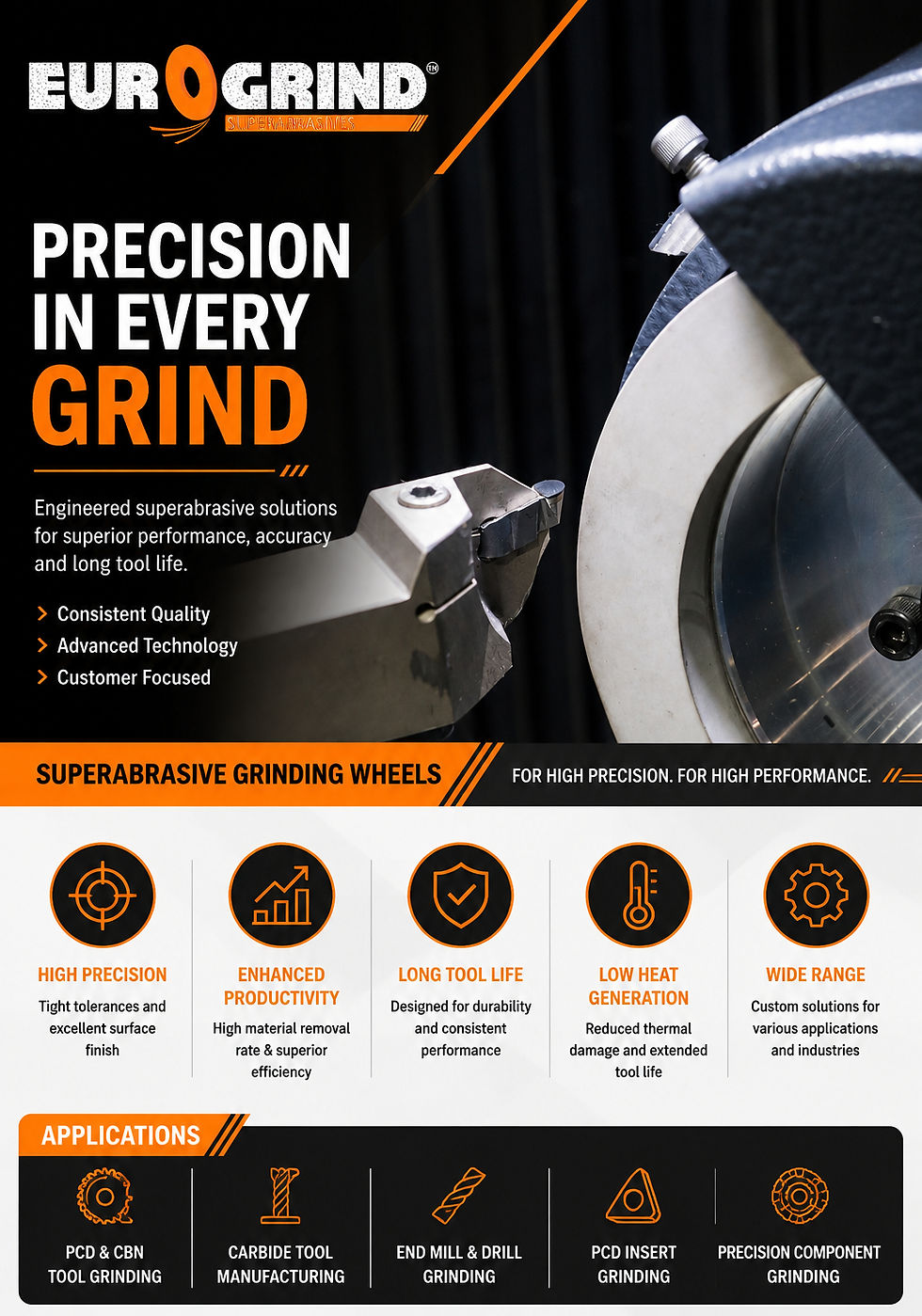
Why Choose Eurogrind Superabrasives for PCD Solutions?
Eurogrind Superabrasives offers precision-engineered PCD tooling solutions designed for demanding industrial applications.
Our expertise includes:
PCD Inserts
PCD End Mills
PCD Reamers
PCD Drills
Custom PCD Tools
Reconditioning Solutions
With decades of experience in superabrasive technologies, we help customers achieve higher productivity, longer tool life, and improved machining efficiency.
Conclusion
PCD tools have transformed modern machining by delivering exceptional wear resistance, superior surface finish, and significantly longer tool life compared to conventional cutting tools.
For industries machining aluminum, composites, graphite, plastics, and other abrasive materials, PCD tooling offers a reliable and cost-effective solution for improving productivity and reducing manufacturing costs.
As production demands continue to increase, PCD tools remain one of the most valuable investments for precision machining operations.


Comments